Thursday, 20 February 2014

The Winter Bushcraft Challenge


Bushcraft training and survival training are often thought of as two quite different creatures however, there is a point where the two merge and cross over. The Winter Bushcraft Challenge which took place at our Wiltshire woodland site last weekend, is definitely one of those hybrids. Designed as a testing 48 hour exercise, it aims to address some of the essential requirements for wilderness living from a bushcrafters perspective. Kit, clothing and food are deliberately limited at the coldest, wettest time of the year to truly test the participants understanding of survival priorities, their knowledge and their skill in implementing wilderness survival skills training.

Before signing up, participants must have an existing level of skill and knowledge, including a realistic awareness of survival strategy’s in the event of an unexpected be-nightment at the mercy of the elements. In a typical UK based emergency scenario such as this, the recommended course of action would be to seek immediate, safe shelter and do everything possible to conserve body heat, paying special attention to where and how this might be lost (conduction, convection...). Precious energy would need to be retained for keeping warm during the long night, possibly only invested in improving your shelter or making your position more visible to rescuers. Hopefully by hunkering down in this manner you would be alive, safe and well the following morning.
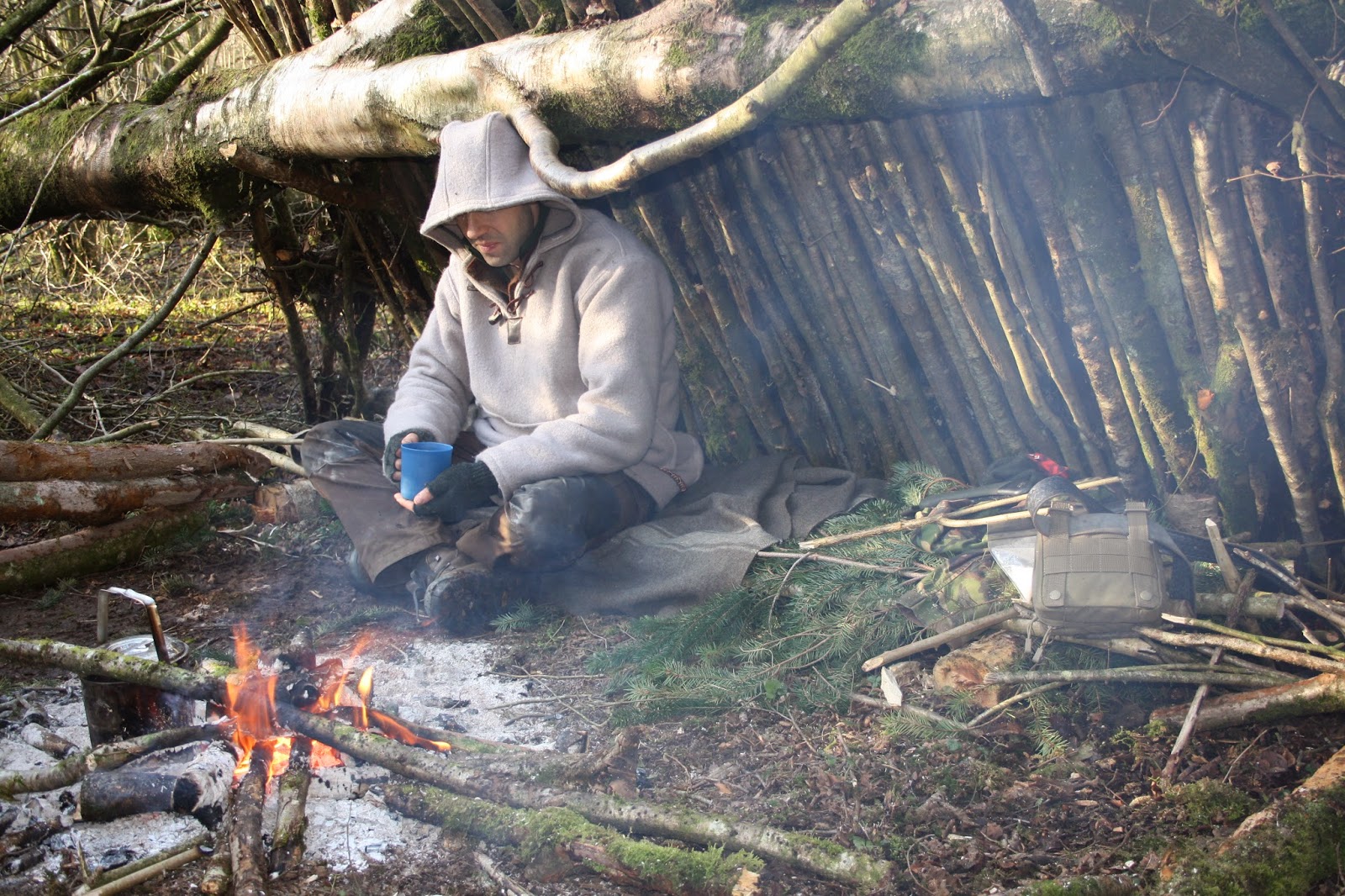
Utilising a fallen birch tree as a shelter framework
 
However, the Winter Bushcraft Challenge seeks to go further than short term wilderness survival and allows participants to fly in the face of logic, speculating to accumulate with a bit of hard graft, making their potentially miserable situation into a positively enjoyable one! Participants are encouraged to brave the elements, possibly putting themselves at greater risk and invest some of that precious energy to raise their survival chances considerably. It’s a double or quits strategy, even more so due to the fact that their clothing choice (each persons own little micro climate) is deliberately restricted to ye olde wool for inner layers, tight weave cotton for outer layers and one wool blanket per person. For these reasons, plus the colder time of year a warming campfire becomes a high priority in this fictitious scenario, where you would most likely be able to get by without one at other times of the year. The ability to light a fire in cold, wet conditions, under increased pressure, with only sparks as your ignition medium and no pre-prepared dry tinder, is an essential skill to develop.
  
 
Burning 'bony oak' for long lasting warmth through the night
 
Additional items on the limited kit list include a belt knife, small folding saw, a Swedish fire steel, one metal cooking pot, a wooden cup and a handful of safety gear (torch, whistle, phone, first aid kit). Participants are also given a small amount of wild game and rice to sustain them for the 24 hour duration. Even this relatively modest meal obviously requires cooking before eating, meaning that energy must be invested before energy can be obtained. Water too, is deliberately difficult to come by and must be boiled before drinking – a mean trick again designed to get participants thinking carefully about prioritising their survival needs. Almost every decision made in such testing conditions carries consequences and there will always be a trade-off. Any mistakes made only serve to enlighten the participants further, providing the kind of personal experience impossible to obtain from a book, demonstration or lecture.

 
A hot cup of pine, fir or spruce needle tea is just the job!
 

Let me stress once again, such a strategy would most likely be a gamble too far in many typical UK survival type scenarios and the kind of natural resources required to build shelter, light fire etc, unlikely to be immediately at hand on your average remote Scottish hillside. I would always encourage anyone venturing out into the wilder parts of this island and similar environments to carry a suitable lightweight shelter system (bothybag, bivi bag, tarp) as well as enough warm layers (blizzard bag, down jacket) and high energy food to help maintain core temperature during the long, winters night. See this suggested packing list for advice

This challenge is less about employing bushcraft skills in a realistic survival scenario and more about encouraging a feeling of self-reliance and total confidence in ones abilities, a heightened awareness of natural resources and less dependency on the reliability of carried survival kits. We’re also preparing for the extremes and the unexpected where a carried survival kit might not provide all the answers. What if it's so cold that just hunkering down won't be enough? What if your clothing and kit are soaked, damaged, inadequate, lost or possibly not even there in the first place? Having confidence in your abilities as well as personal experience to draw upon will ensure a more level head is maintained when sh** meets fan, rather than the onset of panic and a mental barrage of partially retained yet untested information. Your situation may not be exactly the same as this self -imposed practice run but you'll have raised your chances considerably. You’ll know what's possible and what would be dangerous to attempt. Ultimately, you’ll know exactly what you're personally capable of!


Imaginary survival situation aside, your desire to learn bushcraft might stem from an interest in natural history or experimental archaeology. You might have no real interest in survival techniques at all. Reducing kit to a minimum for a challenge such as this puts more emphasis on traditional wilderness living skills, adding meat to their bones and giving them real meaning.

Rear view of a lean to shelter showing the thickness of thatch required to keep the winter weather at bay
 
Don't forget the insulation between you and the cold earth. Here, Doug fir boughs make a perfect mattress
 
Your interest in bushcraft might just be about shedding the confusing clutter of modern life, lightening your mental load, regaining control over your life. The knowledge that you can provide everything you need with your own two hands, hard work and grim determination is unbelievably empowering…even if it is only for a weekend!


You might just enjoy the adventure…

Whatever the reason for learning bushcraft, I like to think of challenges such as these, as a final part of the jigsaw.
 

The Winter Bushcraft Challenge will run again in 2015…but you better be ready! Preparation should include knowledge of building natural shelters, beds, bindings and cordage, well-practiced wet weather fire lighting skills, experience in preparing and cooking various types of wild game, water purification techniques, a good knowledge of wild plants, trees and their uses as well as an honest, hearty helping of just getting out there and doing it!

For everything you need to know, look here


Sunday, 5 January 2014

A Week in the Wilds part 3: Bush Crafts

A Week in the Wilds part 3...the story continues...


With the Hunter Gatherer challenge week already taking bookings for October 2014 I thought I should get back on here and conclude the story of my own experiences whilst taking part in the course during the autumn of 2012. Part one gave an outline of the challenge, what would be required, the tools and equipment we took and explained my own strategy in achieving the basic essentials for survival outdoors, most of which needed to be completed on the first day! Part two took a detailed look at my strategy for gathering, processing, cooking and storing enough wild food to keep me topped up on energy for the week.

During this third instalment I’ll explain the true purpose behind the challenge. Although we were using our bushcraft training to help us locate, gather, process and construct almost everything we needed to help us survive for a week in a wood, the aim of the game was to go beyond just scratching together an existence and delve deeper into improving our situation. Looking to the long term rather than just waiting to be rescued from our self-imposed imaginary survival situation. Once the basics for life had been achieved and food had been gathered we would be looking for ways to become more effective hunters and gatherers, ways of making our homes more comfortable, ways of making our lives more energy efficient. For someone with a lifelong interest in the subject and an ever expanding interest in traditional crafts and ancient life skills this was an exciting prospect…however, you can only hope to achieve so much in a week (my ‘to do’ list had me down as inventing the internet by the Friday and getting everyone else to do my hunting and gathering). This was going to be an exercise in testing bush crafts skill rather than survival.
By entering into the challenge, fully appreciating the true aim I was able to be constantly mindful of the need for certain resources in the very near future, even though other needs ranked higher at that particular moment. In previous posts I have explained that whilst a metal cooking pot turned out to be one of the most essential items of equipment you can have in a situation such as ours was, having only one pot in the kitchen proved to be fairly limiting. Every drop of water gathered needed to be boiled before drinking and survival stew was pretty much the only meal on the menu most days. So, while gathering my first billy of water from the stream, future resource number one was noted…clay. Our wild meat ration came in it’s natural packaging so again, future resources such as hide, sinews and bones were removed and squirreled away. Certain trees were added to the mental resources map if they looked useful for resin, carving wood or cordage. My foraged plants often had non edible parts that could be put to good use such as the easily weaved cattail leaves or the huge leaves of the burdock. If a resource was small enough to be gathered and bought home whilst looking for firewood and food, then it was. Soon my camp began to look like a hoarders paradise, an Aladdin’s cave of crap fit for the compost.

A cattail leaf food preparation mat made by Guy

My first priority, however, was to repay the wild meat loan. The deal here was that all participants started the challenge with a certain amount of wild meat (their only food for the week). The reasons for this marry up nicely with the aforementioned long term survival theme of the challenge and are explained in part 1. To retrospectively ‘earn’ the wild meat we had agreed to meet up on day three with a primitive projectile hunting weapon made by our own fair hands and using only the limited tools and equipment we carried along with any natural resources we could gather. Not only that, but it had to be capable of hitting a target from a suitably realistic hunting distance. We were fully aware that many other factors would come into play if we really did have to hunt wild game with our home made efforts (including a hefty fine or prison sentence in the UK) but given the nature of the challenge, we felt that making an effective weapon and successfully hitting the target would be a perfectly acceptable compromise.
So, I needed a projectile weapon capable of taking down a small deer. Not only that but I had nothing but a small knife and folding saw to make it with, limited time, lower energy levels and limited skill in successfully hitting targets with some of the more basic primitive weapon options. I’ve taken many a rabbit, squirrel or wild fowl with nothing more than a well thrown stick and a hasty follow up in the past but knew that to justify my fortuitous protein head start I’d need something with greater accuracy and packing more of a punch than just wellying a log through the woods. Knowing that a spear would require a lucky encounter or a long ambush and my atlatl throwing skills were about as predictable as the British weather I decided that the only realistic option for reliability and accuracy would be a bow and arrow.
 

Hazel rods stripped of their bark

I’ve made bows before but here, faced a few potential hurdles. Firstly, to make something with a fair bit of power, that could be used over and over in practice would require a seasoned stave of a suitable and readily available wood such as ash. To split out a stave and then remove enough wood to tiller the bow with only a small knife would not be impossible, but would take more time and energy than I was prepared to spare. I had made various ‘survival bows’ in the past too including a bamboo cane ‘bundle bow’ (bound bundle of canes, various lengths with all the bulk in the centre, tapering off towards the end of each limb). These proved to be extremely effective and quick to make…but I didn’t have any bamboo. By way of experimentation and the potential to look a real smart arse if it worked, I decided to use the bundle bow principle with a material I was familiar with, hazel rods. Hazel rods could be easily harvested with knife or saw and very quickly bound in the same fashion as a bamboo bundle bow.
Hazel rods bound with rawhide
 

The binding material needed to have good tensile strength to hold everything tightly in place while being stretched back and forth. Gaffa tape provides the perfect solution if you have your survival kit but the best option available to me was rawhide strips taken from my RPG blasted muntjac deer. As the hide was not in the best condition and I was keen to use parts of it for other projects later in the week, I took just enough for my needs, cut it into strips and left it soaking in a muddy puddle along with some hard wood ash from the fire to help loosen the hair. To be honest, the hair was already coming out by the time I began making my bow and if push came to shove, leaving the hair on wouldn’t have really made a lot of difference to the materials for this task.
The finished bundle bow with paracord bow string
 

As the bow was to be used in quite close cover, I decided on a short but hopefully powerful model. This was to be mistake number one (but I didn’t realise yet). A shorter bow would be less cumbersome to sneak around with in the woods and easier to use from dense cover. The theory was that I should be able to stalk closer to the deer in woodlands too meaning that the range of a longer bow wouldn’t be so important. A shorter bow also meant less lashings leaving more hide for other tasks. I cut several likely looking hazel rods, stripped the bark with the back of my knife and arranged them in size order. Bundling them together and lashing them tightly with the stretched and slightly damp rawhide, I gave the clumsy looking bow a tentative floor tiller. It creaked and complained a bit but felt extremely robust and springy! I re-positioned and straightened the rods, re-tightened the rawhide as best as I could and hoisted the bow up in the smoke and ambient heat from my campfire to dry out overnight. Now redundant, the paracord from my bow drill set looked like the best choice for a bow string so I tied a loop in one end and fixed it to one limb of the bundle bow ready for action.
Next, the arrow...
For the arrow, I used another thinner hazel rod cleaned of it’s bark and scraped to a more even diameter along it’s length. Any bends and crooked sections were heated over the fire, then held just beyond the straight until the wood cooled. Finally, I scraped the wooden shaft with a sharp flint edge and using my folding saw, carefully cut opposing notches at either end for the arrow head and string nock. The fletchings came from one wing of an unfortunate wood pigeon who had become lunch for a fox by the looks of things. I carefully trimmed these to sit tightly against the arrow shaft and bound them in place with sinew. I used back strap sinew taken from the muntjac deer as it needed very little preparation and was pretty much good to go after being dried, smoked and re-dampened.
 

Close up of pigeon wing fletchings tied with sinew
 

The scraped and dried muntjac back strap sinew
 
For the head I made a very simple flint point by basically smashing the hell out of a small nodule and sorting through the shards until I found something roughly around the right size and shape. This was coaxed into a slightly more recognisable arrow head with a few carefully placed taps from a pebble sized, slim hammer stone. Earlier in the day I had gathered some pine resin leaking from a bark scar and this was softened by the fire on a hot rock then mixed with finely powdered charcoal to add strength. Using this make shift hot melt glue I fixed the arrow head to the shaft, additionally binding the fixing with sinew then covering the whole caboodle with more resin. It must be said that after the frantic first couple of days building my temporary home in the woods and laying on all the services, the whole bow and arrow making episode felt like a huge and obvious transition from one stage to the next. In fact, lying on my home made mattress, surrounded by darkness and hooting owls, survival stew bubbling away, working next to the light of the fire I couldn’t remember a time when I felt more contented out in the woods.

 
The day of reckoning arrived! I’d put together a ‘range’ where we would all meet and now here we were brandishing several dangerous looking weapons including spears, dutch arrows, darts, throwing sticks and a couple of bows. After several days living wild in the woods we all looked (and smelt) like the theoretical animals we would be hunting. Having previously discounted spears and throwing sticks, in the right hands they were looking decidedly lethal and making a mess of my target board!

 
"Get to the chopperrrrr..."
 

My hazel bundle bow worked ok, hitting the target where it needed to but would’ve benefitted from a few evolutionary tweaks. I used green rods which meant that the bow wasn’t as ‘snappy’ as it could’ve been (but there’s a very fine line between gathering seasoned hazel rods and gathering kindling). Also, for next time I would increase the length of the bow for more draw weight and power as well as making the lightest arrow I could get away with. I know this because Dave (the android) had managed to rustle up an ash self-bow with some very thin hazel arrows and a thinner bow string made from inner paracord fibres. His super light arrows and springier bow combo was the Usain Bolt to my Bella Emberg. I mumbled some stuff about my heavier arrow causing more haemorrhaging but we all knew whose bow had bought home the bacon. A lesson learnt…don’t try to be a smart arse!


Dinner!
 
Lessons learnt, I sloped back off to my den in the woods to try my hand at a bit of wild pottery. The water level down at the stream was much lower than usual and as a result, a good amount of clean and useable clay was clearly visible and easily gathered. I hauled back as much as I could, also hunting down an old house brick from a foresters bonfire to use as a temper and a hefty hammer stone to crush it up with. I hadn’t had a great deal of success with previous pottery experiments but knew this was mostly to do with the fact that I often tried to squeeze these experiments into a ridiculously tight time schedule. You can’t rush something like primitive pottery, but here I had time to do a better job. So I worked the clay in my hands as much as possible, clearing out any obvious, potentially problematic pieces of debris as I went. With my clay cleaned as well as it could be in the circumstances I wrapped the burnt house brick up in a t shirt and bashed it to smithereens with the hammer stone until it was reduced to a fine red powder. Thinking of Dave and his stupid bow really helped here (only joking Dave).

Stream bank clay with burnt, crushed house brick temper


This was worked into the damp clay at a ratio that seemed about right. I pushed, pulled, prodded and pinched the ball into a sort of shallow bowl, dish kind of thing trying to get it as smooth and as even as possible even at this early stage. It was then hidden away to begin drying out in the driest part of my shelter, not too near the heat from the fire. As soon as the clay felt like it was firming up I took a sharp slither of stone and began scraping and smoothing the inside and out to an even thickness, filling any tiny cracks that appeared with the slurry I had created by scraping. The happier I became with the bowls progress, the more trepidation I felt about firing it. Previous firings had resulted in some disappointing but dramatic mini explosions.


I let the bowl dry some more then carefully etched a pattern around the rim as decoration (trying to be a smart arse again..). Now, feeling dry to the touch the bowl found a new, warmer home just inside the stacked log wall surrounding my fire place. I knew that despite feeling dry, it would only take a few drops of water to revert this bowl, dish thing into wet clay once more so firing was the only answer…but not too soon. My plan was to gradually move the bowl closer to the fire over a period of days, finally allowing the fire to claim it for a proper, fierce firing right in the heart of the coals and flames on the final day. In fact, I went home with the bowl dry but not yet fired. The firing happened whilst running a course a short while later (I think we were heating up rocks for an underground hangi oven or something). As you can see, despite a few authentic looking cracks, none of them life threatening, it survived the process! There’s certainly room for improvement but it’s a good step forward.

 
As the days ticked on we all found time to work on different crafts in addition to feeding ourselves, staying warm and sheltered. We whittled pot hangers, spoons and other treen, wove brambles into baskets and leaves into food preparation mats. Myself and Guy had some buckskin pouches to put together  (admittedly these were made using our own previously prepared buckskin we’d bought along but at least we had the spare time).

Various crafted items: bramble stem foraging basket, clay bowls, carved spoons, venison jerky, a roughed out kuksa cup and buckskin pouch
 
Guys buckskin pouch with bone toggles

Once we’d fought through the first couple of days and established a routine we seemed to have quite a bit of spare time, however I’m under no illusion that, for the purposes of this exercise I had chosen a location with plenty of accessible wild foods growing nearby. Also, we were just entering a time of year when, not only was it still pretty warm but in wild food terms it was certainly a time of plenty. Additionally, we were all in good health and only there for a week so this personal experiment cannot be considered a realistic example of how bushcraft training can help a modern human successfully revert back to hunter gatherer status. Everything is relative though and I still maintain that without the skills we had spent years honing, our week living wild would’ve been over in the first 24 hours …. and even if we had managed to stay alive, we certainly wouldn’t have been as comfortable!


If you fancy trying your hand at the Hunter Gatherer Challenge in October 2014, get in touch to discuss pre-course preparation or visit the website page here
We're also running a Winter Bushcraft Challenge in February which is designed as a perfect warm up (probably not the best choice of phrase) for those who have the intention of attending the Hunter Gatherer later in the year.
Thanks for reading. Hope you enjoyed it!


Sunday, 24 November 2013

If spoons could talk...


Just looking at some of the whittled spoons I have hanging around in the kitchen whilst waiting for the toast to pop up and the kettle to boil this morning. Every one of them has a story to tell – many are the product of heading out to the woods, sometimes with no agenda other than to go home with a new creation. A spoon is clearly a functional item, as is a basket, bowl or cup, a bark container but carving a spoon goes way beyond the need for a tool to shovel food into face. The materials have been harvested paying close attention to the type of wood and their differing properties, the condition of the timber, maybe even the time of year. The finished piece bears the ever-lasting marks of your hard work, perhaps giving others an indication of your craftsmanship but more importantly on a personal level, serving as a physical reminder of where you were, who you were with, what you were thinking as you carved. Such an investment of time and labour imprints these memories deep within the wood grain itself, far better than any photograph. As time passes, a unique patina develops through use telling a story all of it’s own… 


Here's a handful of favourites, starting at the bottom with the crook knife (don't try and eat your cereal with that one..) and turning clockwise through the photograph:


1.     A Ben Orford small standard crook knife with a hybrid handle which lives in the lid pocket of my daysack. Excellent for spoon hollowing and thanks to the extended, curving handle great for larger projects too. You need this tool in your life!


2.    Oak spoon – carved on a winters day whilst being not particularly successful at hunting rabbits on the Sussex estate where my brother in law works as a game keeper. The green oak was easy to carve and showed the characteristic oak medullary rays in the spoon bowl before greying through use. This one is probably about thirteen years old.

3.    Little Cedar spoon – carved whilst sitting next to a campfire in Morocco around ten years ago, surrounded by sand dunes and stars. The bowl is shallow because I hadn’t packed a crook knife so used the curved tip of my pen knife instead. I increased the bowl depth slightly through burning using a glowing ember from the fire, then sanded it smooth with sand grains and cloth.

4.    Small Ash spoon – carved as a demonstration several years ago, this little spoon became the camp coffee spoon, hence the dark colouration in the bowl. I lost it after a course and suspected a shady character who had been admiring it all week, of it’s theft. Six months later I found it again hidden under the leaves where the washing up bowl is often emptied and had to forgive the formerly accused and entirely innocent person quietly to myself.

5.    Extremely curvy birch spoon – Again, another demonstration piece however, this one started life as a dramatic failure. Whilst demonstrating the benefits of a ‘stop cut’, I didn’t stop at all and ended up shearing off the whole of one side of the bowl. I can still hear the laughter (not mine obviously..)! After this shameful episode I persevered and ended up carving a smaller spoon using the extra bit I normally leave on either end of a spoon blank ‘just in case’. So the shape is a little strange but it has it’s own unique elegance and is probably perfected suited to some sort of role somewhere….just need to find it.

6.    Ash spoon, also from the lid pocket of my daysack – the last remaining (not finished) member of a set of four similar spoons. The other three were slowly seasoning in a bin bag when they were mistakenly included with the rubbish and chucked out! A warning to fellow forgetful folk…

7.    A beech eating spoon – this is my current eating spoon. The bend in the handle isn’t intentional, instead the result of warping as the wood seasoned. As it happens it curls round my hand perfectly! The other half of the split beech limb was carved into a spatula and has also warped in the same way to make a perfect matching set.

8.    Sweet chestnut spoon – made during a bushcraft course attended after leaving the army quite some time ago. Made some good friends and learnt some fantastic skills. The lead instructor was a quietly understated but extremely skilled Swedish chap. He had a good look at the spoon (my first ‘proper’ hand-made wooden spoon) and told me to go away and make another, but this time just using an axe. I think it was his way of telling me I’d passed that particular test.

9.    Black oak spoon – carved in Portugal from seasoned wood about eight years back. Extremely hard work, my thumbs never forgave me! This served as my eating spoon for a while and could probably have doubled as a club for knocking out tiny assailants.
Make some memories - happy carving! 


Monday, 18 November 2013

Packing your kit for winter:


With the winter of 2013/14 apparently about to be the worst since 1947, we're set for some seriously chilly weather. Despite the seasonal media doom mongering, it's no revelation that winter is cold in the UK! This should most definitely not mean putting your outdoor kit into storage until spring - the colder months are some of the best times to get outside. You'll probably have the place to yourself for starters! At first glance, the stark landscape and sleepy, quiet woodlands suggest that there’s not much going on and that the best place to be is snug and warm indoors, but it’s well worth pulling on your thicker socks and silly hat with the ear flaps and going to take a look for yourself.  The winter snows bring their own set of seasonal bonus’s to the bushcraft enthusiast; greater opportunities for tracking is just one. Not only is it easier to pick up sign but it’s far easier to interpret and follow a track from start to finish. This is helpful for confirming certain theories that are otherwise difficult to interpret correctly at other times of the year. This information, once confirmed can be of great use when using knowledge of a certain animal’s behaviour to fill in missing gaps along a trail at other times of year.

If you have set out to learn bushcraft skills as a form of insurance should something ever go wrong then to gauge progress, occasionally it helps to test yourself. Skills that come easy in the summer will be that much harder in the winter months as the harsh weather and difficulty in identifying resources throw up all sorts of additional limiting factors. Fire lighting, tree and plant identification, navigation are all outdoor skills that require a real in depth understanding which is fully tested to the limit in the winter. By practicing and mastering important skills such as these in the winter time your confidence will be increased dramatically at other times of the year. Train hard, fight easy as they say...

Above all, waking up in a snowy forest is the stuff of fairy tales. If properly kitted out and equipped with sound knowledge of the winter environment then to a certain degree, snow can be your friend offering insulation, building materials and even drinking water. Any light from the moon is enhanced greatly on the surface of a snow covered woodland floor allowing some fantastic night time wildlife encounters that would otherwise be missed.  But cold, wet conditions can rapidly increase the speed at which things go wrong if caught out unprepared. Practicing skills that could save yours or others lives is important but you must have a back up plan when the cold weather hits. Before venturing out it’s a good idea to spend a bit of time preparing to ensure that you could take care of your own survival should the unexpected happen and you find yourself stranded between A and B at the mercy of winter at it’s most wintry. 

Keeping things simple is always important and initially it makes sense to settle on a packing system that works pretty much all year round, only needing a bit of tweak for extreme weather conditions or different environments. When tweaking your packing system for a trip in winter, give some thought to whether or not your kit would realistically keep you sheltered, warm, hydrated and fed if you had to spend an unexpected night outdoors. Additionally, could it enable you to call for help, guide in rescuers or even self rescue before things got out of hand?  In light of the annual stories of unfortunate travellers stranded overnight on snowy motorways, it seems that any winter journey could result in a chilly, potentially life threatening experience if things don’t go to plan. It pays to be prepared and a well thought out, fully packed winter survival bag could serve you just as well kept in the boot of your vehicle as it could out on the hill. Additionally, if the zombie apocalypse begins while you’re out doing the shopping you’ll be laughing all the way to the fortified survivors compound.

Here’s a suggested winter packing system for a day out walking or an emergency bag to be kept in the back of the car. The rucksack shown has a 45 litre capacity which should really be seen as the minimum size for a winter day sack:


Lid / outside pocket:  Items you might need in a hurry:
 
Keep the following items in the lid pocket or a side pocket so they’ll be close to hand without having to tip the contents of your bag out all over the snow...


1.  Good head torch with new batteries, powerful beam and preferably some additional features (the Alpkit gamma shown has all sorts of flashing, different coloured and different strength beams).
 
2.  Tough, flexible, waterproof pouch containing phone as well as a spare battery or reliable, portable charging system. My waterproof pouch has a lanyard so it can be attached to my rucksack. I also carry a second ‘cheapy’ phone that uses a different network to double my chances in areas with poor signal.
 
3.  Compass, whistle, notebook, pencil and waterproofed map (map not shown here). Forward thinking mountain navigators also have a spare map, sometimes of a larger scale hidden away in the main body of their pack. Maps can suddenly become tiny un-piloted para gliders without warning on windy days...
 
4.  Back up mittens: In winter time, especially out on the hill if your hands are frozen you’ll get into serious difficulty. Putting up shelter, lighting a gas stove, even using a map and compass becomes virtually impossible with numb hands. In the event that your primary pair of gloves becomes ineffective after a good soaking, or even whipped out of your hands by the wind, you won’t want to faff around too long looking for replacements. Keep a warm, weather-proof but easily packable pair sealed in a small drybag (Buffalo make excellent pertex and pile mitts for this purpose) in the hood pocket. Basically somewhere you can reach with your teeth if needs be!
 
5.  Toilet kit: the last third of a toilet roll and some anti-bacterial hand gel in a ziploc bag is a better option than looking for soft leaves on a hill side in winter!
 
6.  High energy snacks (not shown, or eaten. Probably eaten)
 
Main body of the rucksack - top layer:  Shelter and warmth


1.     If not already worn you’ll want your waterproof jacket right at the top ready to don if the heavens open. In this day and age, your main jacket should really be made from a waterproof and breathable fabric with taped seams, weather-proof closures, a good hood and pockets. I hate wearing too much when on the move so avoid wearing mine whenever possible, instead opting for a lightweight windproof hooded top and thermal shirt underneath. If you feel the same then you must ensure that your winter walking top is at least windproof, preferably showerproof. Constantly battling the wind chill will use valuable energy and mean that you’ll rapidly cool to the point of shivering whenever you stop moving. A windproof top keeps the wind-chill at bay and traps much of your own generated body-heat next your body where it belongs. There are loads of windproof, quick drying, lightweight and highly breathable fabrics out there that don’t feel like you’re wearing a bin bag. Montane, Rab, Paramo and Buffalo all make good lightweight windproof tops.

2.    I also keep a warm hat in the pocket of my waterproof jacket and make sure the jacket is arranged with that pocket being the first thing I see when I open my rucksack. It’s amazing how much warmer you feel if you pop on a hat when you stop for a brew or to check the map. Almost like putting on another layer! A snood, buff or whatever the latest strange name for a warm neck covering is, should also be kept here for the same reason.

If you carry them, waterproof trousers should be stowed here too.

3.    Keep a mid-weight windproof and warm top near the top of your bag, just under your waterproof jacket. I favour a gillet if I’m on the move or working hard as it’s less restrictive on the arms; synthetic fill insulated job when out in the hills and dense wool if mucking about in the woods. Top tip; if your warm top has a full length zip then keep it zipped around a third of the way up and pull it on over your head. Trying to get the two halves of a zipper to connect with cold fingers or big gloves on when the wind is picking up is not easy. Also, when removing clothing such as jackets to add another warm layer underneath, keeping the bottom section of the zip, zipped means it can drop down out of the way still fastened around your knees but not be completely free to be suddenly blown awaaaaay across the hills.

Also shown here, sunglasses are handy for protecting your eyes from the glare of the snow and more importantly, will magically transform a boring looking rambler into a polar explorer or adventure racer!

4.    In the winter, especially if walking primarily in exposed areas it makes sense to carry a lightweight shelter of some sort. If stopping for a rest it can be quickly set up to provide protection for you or a small group and if stranded out overnight it could be a lifesaver. When I’m in the woods I take a lightweight, waterproof tarp (currently an Alpkit rig 7 – fantastic) with guy-lines fitted so that I can set up some overhead cover to work under in the rain. When out on the hill an emergency ‘bothy’ bag would be your best bet. These can easily be whipped out and used to create a sheltered place for lunch. My rig 7 tarp is about the same size as a two person bothy bag when all squished up, basically very small indeed. If you carry walking poles a tarp can even be set up like a small tent out in the open but you’ll need some origami training first.

5.    If you have an old foam sleeping mat then it’s a good idea to cut out a section as long as the height of your rucksack and twice the width. Fold it in half along it’s length and slip it down inside the main body of your rucksack to sit against the existing back padding. This can be pulled out to sit on whenever you stop for a rest or in an unplanned overnight emergency, used to provide vital insulation between your body and the ground. Although smaller than a full size mat, you can at least provide protection for your torso with your empty rucksack and other kit providing some ground insulation for your legs. It also gives a bit more padding to the back of your rucksack when packed!
 
Middle layer:  Food, water, stove, essential kit


1.    Drinking system:    I’ve had problems with hydration systems in the winter (frozen hoses) so carry my water in a hard, plastic 1 litre bottle with a wide mouth. Hunt around for a bottle that will fit neatly inside a large metal mug so that these two bed fellows can stay permanently locked together in your kit. A metal mug can be used to cook in, melt ice or boil wild water to make it safe to drink. Keep your water bottle/mug combo in a pouch along with a spoon, a metal lid for the cup (to speed up the heating process), a cloth water filter bag and some water sterilization tablets or similar water purification device.

2.    One litre of drinking water isn’t really enough so carry a second water container. In the winter months this may as well be a small stainless steel flask filled with a hot, sweet brew! Looking for a good place to keep your gaffa tape? Wrap a load around your flask and water bottle.

3.    Food:    Winter walking grub needs to be highly calorific offering both quick and slow releases of energy. Time to raid the Christmas selection packs! If heading out for the day then choose food that matches this criteria but also concentrate on foods that don’t necessarily need to be cooked. Obviously heating your food in the winter is recommended but if stove fuel is low, it’s good to know that your only available meal option doesn’t involve crunching your way through cold powdered potato sachets (been there...). Also, take more than you need for the day – pack for an unexpected overnight camp out. If you’re packing a rucksack for a potential emergency then 24 hours of highly calorific food needn’t take up that much room if you spend time shopping for the best options. If you’re annoyingly organised you can separate meals into different ziploc bags with a separate one for brew kit. Incidentally, replace milk or milk powder for the sweet, condensed stuff in a squeezy tube which can also be guzzled in an emergency and tastes yum in a coffee.

4.    Cooking pot, stove and fuel:    If you won’t be able to light a cooking fire (open terrain or not permitted) then a cooking stove is essential. Ideally, carry a small but effective stove that will fit inside your main cooking pot for protection. To stop everything rattling around your stove should also be kept in a cloth bag or wrapped in a tea towel within the cooking pot, along with a lighter and spare fuel if it fits. As your pot is likely to be dirty on the outside this should be kept in a dry bag of some sort leaving room for a flexible or folding windshield to speed up cooking times and save fuel. A word of warning though, always make sure that gas stoves which have an integral fuel compartment don’t get too hot due to your reflective windshield being too close and surrounding the stove completely, or you could end up wearing your dinner as a hat. Leave the windshield open on the leeward side to keep the fuel compartment cool. Never cook inside a tent without proper ventilation due to the risks of carbon monoxide poisoning and it goes without saying that in the event of a vehicle breakdown or becoming stranded overnight in the snow, cooking inside or even near a vehicle is an extremely stupid thing to do!

Obviously there’s a limit to how much stove fuel can be carried so if carrying extra food, and travelling somewhere where lighting a fire may not be possible, it makes sense to also carry an emergency cooking source and for this you can’t go far wrong with a small packet of solid fuel tablets. A small pot support can then be improvised with sticks or rocks. There are also a number of ingenious little portable wood burners which maximise the effectiveness of natural fuel sources (such as dry bark, pine cones etc), leave nothing but ash, are much safer than a full on campfire, weigh virtually nothing and take up little more room than a birthday card when packed. Worth adding to your stove bag for sure. 

5.    Bits and bobs bag:    This bag contains a number of essential items which may be needed during the day as well as spare back up kit to some of your most important gear. It’s also a stand alone survival kit if needs be. A detailed breakdown of mine can be found here.

6.    Bushcraft tools – belt knife and folding saw:    With a good multi tool in your bits and bobs bag, cutting tools aren’t really essential kit to the average walker. However, to those who intend to go off the beaten track or have taken time to learn how natures resources can be utilised to your advantage, good cutting tools are definitely not leave at home items. After all, how the hell do you expect to whittle a wooden spoon without them? Don’t forget that if your rucksack is to be carried in a vehicle ‘just in case’ then the carrying of fixed bladed or folding lock knives needs to have a good explanation if you find yourself being stopped by the police for any reason. Use your common sense here. A machete strapped to the outside of a rucksack on the rear parcel shelf is asking for trouble.

7.    A first aid kit should always be carried but especially if using sharp cutting tools. Some of the items from larger kits (such as slings, folding splints etc) can be improvised so unless you’re intentionally heading off into the wilderness for an extended period your first aid kit need only consist of stuff that might actually be needed. My personal kit has plasters, blister plasters, steri- strips, antiseptic wipes, painkillers, zinc oxide tape, latex gloves, tweezers, sterile wound dressings, antiseptic cream, a crepe bandage and a small tin of vaseline (good for cracked lips, rubbing toes and chafing). Because I often use sharp cutting tools whilst a bit further away from medical assistance, I also carry a large military wound dressing and a small packet of haemostatic clotting agent. There's normally room for this mini kit inside my 'bits and bobs' bag.
 
Bottom layer:    non essential emergency gear and spare clothing:
 
 
1.    Before deciding what emergency gear to pack in the event of becoming stranded outside all night, I can thoroughly recommend attempting exactly that as part of a safe, supported and controlled experiment. I have on several occasions and the bitter experience gained means that the kit I carry now has just the right balance between real performance and small pack size. Rather than increasing my slim chances of survival by just a tiny amount, the comparatively small increase in weight and volume will ensure that I see the next morning with relative ease. A huge leap forward in survival kit technology is the emergency ‘reflexcell’ gear made by Blizzard. Blankets, bags and even jackets are all available. These are made from layers of reflective foil with compartments sandwiched between the innermost and outer layers designed to trap your warm air. I carry the Blizzard sleeping bag which comes vacuum packed to the size of a video cassette but has the warmth rating of a medium weight sleeping bag! Peace of mind if trapped outside in cold conditions overnight.
 
2.    Super warm top:    Again, you should be looking for maximum performance with minimum weight and bulk here. Down or high performance synthetic fill jackets fit the bill perfectly squishing down to almost nothing but keeping you extremely warm when worn. Your super warm top should be kept in it’s own waterproof brightly coloured and labelled bag so it can be easily found down there in the depths of your rucksack, only seeing the light of day in an emergency, during an extended stop or at much colder times of the day. If stuck out all night it’ll really turn the tables in your favour when worn inside a blizzard bag. Such an extreme garment should have a hood for maximum warmth and if it’s sole purpose is as a last resort layer then buy a size bigger than usual to allow for extra layers underneath.
 
3,4 & 5.    Lastly, right at the very bottom of your rucksack is a mysterious waterproof bag containing a full change of clothing, only to be opened in a dire emergency. A full change of clothing sounds like a bulky and heavy over indulgence for a day bag and not everyone goes to such lengths. In fact this part of my kit is only included if the weather is absolutely horrendous, if I’m heading well off the beaten track or if I’m planning on staying out for a couple of days. However, when you’re out all day at the mercy of the elements, even expensive waterproof clothing has been known to give up the ghost and let moisture in. You may even slip into a cold river and get a soaking! Despite sounding like a bulky package, a full change of clothes can be trimmed down to the bare essentials. A full set of wool thermals, spare warm socks, gloves, a balaclava, and a windproof suit made from para-silk or pertex squashes down to a surprisingly small package and will provide a warm, dry and protective layer next to the skin. With your super warm jacket on top you’ll be back in the game in no time.
 
For walking on steep, snow covered ground you’ll also need various specialist equipment such as crampons, an ice axe, snow shovel and avalanche probe but really, anyone needing to carry this kit should book themselves onto a winter mountaineering skills course first as the knowledge gained here WILL save your life. Check out Rob's site for just such a course. Rob’s an absolute diamond of a bloke – you’ll be in safe hands!
 
Hopefully the above advice will be of use to you. Enjoy the season!